Strategic Investment
First 5 Sacramento’s vision is that Sacramento County will have strong communities where children are safe, healthy, and reach their full potential. To this end, First 5 uses tobacco tax revenue through Proposition 10 to support early childhood development through advocacy, systems improvement, and by funding a range of essential prevention and early intervention programs for Sacramento County children ages 0 to 5 and their families. Because the tobacco tax is a declining revenue stream, First 5 has honed its investments over its 25-year history, shifting funding away from direct-services programming toward more systems improvement and policy work where impacts will be greater and longer-lasting. This trend continues in the current Strategic Plan. The entire strategic planning process was designed to center racial equity, to be highly inclusive, and to be data-informed. The resulting plan outlines the priorities and goals for investing $44.6 million over its three-year term.
In support of its mission, vision, and foundational principles, First 5 Sacramento has prioritized five areas of focus for long-term investment (2024 – 2034): Racial Equity, Quality Child Care, Health & Well-Being, System Improvement, and Parent Partnership.
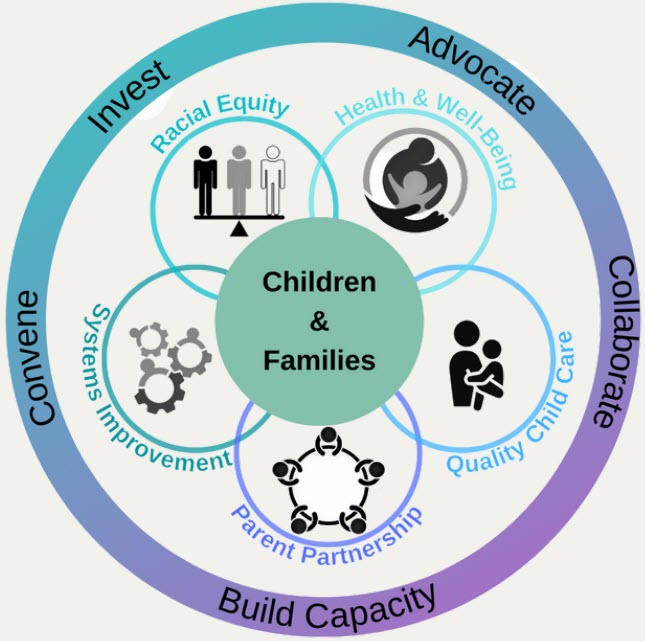
Outcome:
- Racial Equity, Diversity, Inclusion and Cultural Responsiveness (REDI+CR) is strong across all priority areas
- F5 Sac has invested in underserved communities
Goals:
- Update, implement, and evaluate First 5 Sacramento’s REDI+CR Plan
- Build the capacity of non-traditional partners/smaller community-based organizations
- Fund new and non-traditional partners to effectively address community-led plans to support young children and families
Sample Strategies:
- Implement a comprehensive plan to communicate the Commission’s REDI+CR Initiative
- Revise policies, procedures, practices, protocols and publications to insure racial equity, diversity, and inclusion
- Explore and create a separate funding pathway specifically to engage non-traditional partners
- Change procurement policies to enable new, grassroots agencies to contract with the Commission (i.e. providing advances, loosening insurance requirements, revising scoring tools, revising review panel composition to include target populations, creating non-competitive processes for small CBOs)
- Explore/implement a participatory funding process within identified under-resourced communities
Outcome:
- Children are connected to affordable, quality child care and early learning
Goals:
- Ensure a coordinated county-wide effort that effectively advocates for the prioritized needs of the child care community
- Increase providers’ access to and engagement with quality child care supports
Sample Strategies:
- Co-fund a county-wide child care coalition to improve access to highquality, affordable, and equitable early learning and care across Sacramento County
- Strengthen and build capacity of child care providers through coaching and technical assistance and leverage F5CA IMPACT funding
- Support collaboration and coordination of behavioral consultation for private child care providers and leverage MHSA funding
Outcome:
- Children are born healthy and achieve optimal physical and mental well-being
- Children’s basic needs are met so they can reach optimal development
Goals:
- Increase whole-child and family-centered services to support the well-being and safety of children and fortify family strengths
- Reduce perinatal health disparities for parents and infants through culturally responsive programs and services
- Strengthen children’s social-emotional development and increase early detection of developmental and behavioral health concerns among infants and toddlers while
Sample Strategies:
- Increase parents’ access to culturally responsive information and supports that reduce health disparities and infant mortality, while improving birth outcomes by providing prenatal and postpartum screenings, pregnancy coaches, and doulas
- Fund place- and home-based, family-centered services and supports in high-opportunity neighborhoods that help parents solve problems and fortify family strengths in order to promote child safety and well-being
- Expand opportunities for families within target neighborhoods to access concrete supports, grow parent knowledge, build resilience, increase social connectivity, and strengthen children’s social-emotional competencies
- Support community efforts to increase awareness of and access to financial supports, including addressing barriers, streamlining application processes, and identifying advocacy opportunities
- Optimize nutrition from pregnancy through 24 months postpartum through lactation consultation
- Promote and expand Help Me Grow Sacramento and advocate to increase compliance with screenings in the medical home
- Support positive parent-child interaction and reduce isolation by funding developmental playgroups
- Support children’s social-emotional development through training / coaching of early childhood providers
Systems Improvement
$1,397,195/ 3 years
Outcome:
- Children are connected to affordable, quality child care and early learning
Goals:
- Ensure a coordinated county-wide effort that effectively advocates for the prioritized needs of the child care community
- Increase providers’ access to and engagement with quality child care supports
Sample Strategies:
- Co-fund a county-wide child care coalition to improve access to highquality, affordable, and equitable early learning and care across Sacramento County
- Strengthen and build capacity of child care providers through coaching and technical assistance and leverage F5CA IMPACT funding
- Support collaboration and coordination of behavioral consultation for private child care providers and leverage MHSA funding
Parent Partnership
$1,047,897/ 3 years
Outcome:
- Parent/ caregiver expertise is lifted up across all priority areas
Goals:
- Cultivate parent/caregiver leadership in Sacramento County
- Allow parents to have decision-making power within First 5 Sacramento’s programs, policies, and practices
Sample Strategies:
- Continue support for an intensive parent leadership training program
- Support and implement a self-paced, web-based parent advocacy and leadership curriculum
- Connect parents to advocacy opportunities at the local, county, and state levels
- Create ongoing opportunities for the community to provide feedback on community strengths and needs and inform First 5 program planning, funding allocations, and policies